What is Lumvoa?
Lumvoa is a prescription medicine used to treat thyroid eye disease, also known as TED. Lumvoa can help relieve symptoms in people who are newly diagnosed or have been living with TED for a long time.
How Lumvoa works
Lumvoa's mechanism of action is not fully understood, and is based on laboratory studies.
In TED, the body's immune system mistakenly attacks the muscle and fat tissue around the eyes. This can cause swelling, inflammation, and a buildup of tissue around the eyes
Lumvoa is designed to block signals on cells that play an important role in driving the inflammation and tissue changes seen in TED
By blocking this signal, inflammation and swelling behind the eyes may decrease and improve symptoms
Getting started with Lumvoa: what to expect
This short video reviews the 12-week treatment process with Lumvoa. You'll learn about TED, how Lumvoa works, what to expect during your treatment, and the most common side effects. It also introduces ViridianCares™, which can help you navigate insurance, scheduling, and financial support.
00:00:00:03 - 00:00:30:14
Getting Started with Lumvoa (veligrotug-vvze): What to Expect. Chapter one. Understanding thyroid eye disease. Thyroid eye disease, or TED, is an autoimmune condition characterized by inflammation, growth and damage to tissues around and behind the eyes. In severe cases, it can lead to damage to the eyes and even loss of sight. Chapter two. About Lumvoa. Please review the important safety information at the end of this video.
00:00:30:17 - 00:00:55:28
Lumvoa is a prescription medicine used to treat thyroid eye disease, designed to help relieve symptoms in people who are newly diagnosed or have been living with the condition for a long time. In thyroid eye disease, the body’s immune system mistakenly attacks the muscle and fat tissue around the eyes. Lumvoa is designed to block signals on cells that play an important role in driving the inflammation and tissue changes seen in TED.
00:00:56:01 - 00:01:23:06
By blocking this signal, inflammation and swelling behind the eyes may decrease and improve symptoms. Chapter three. How Lumvoa is given. Lumvoa is an IV or intravenous medicine, which means it is delivered directly into your bloodstream through a needle placed in a vein – usually in your arm connected to a small tube. A full course of Lumvoa is five infusions given three weeks apart over twelve weeks.
00:01:23:08 - 00:01:50:13
The first infusion will take about 45 minutes, and if well tolerated, the rest take about 30 minutes each. Chapter four. Lumvoa provides relief in TED. Whether you’ve been recently diagnosed or have had TED for years, treatment with Lumvoa can help reduce your symptoms.In clinical studies, some people on Lumvoa saw reduced eye bulging (proptosis) in as early as three weeks.
00:01:50:15 - 00:02:32:23
It’s important to complete all five infusions of Lumvoa. Chapter five. The common side effects of Lumvoa. The most common side effects of Lumvoa included muscle spasms, headache, hearing problems, high blood sugar, tiredness, diarrhea, ear discomfort, infusion reactions, nausea, cold-like symptoms, increased blood creatine phosphokinase or CPK, dry skin, high blood pressure. Most side effects were mild or moderate and got better during or after treatment.
00:02:32:25 - 00:02:58:01
Talk to your doctor if you are experiencing any side effects while on Lumvoa. Please see additional important safety information at the end of this video. Chapter six. Getting started with Lumvoa. Cost and patient support. Now that you and your doctor have decided Lumvoa is right for you, let’s talk about what comes next. ViridianCares is here to support you throughout your treatment.
00:02:58:04 - 00:03:23:01
Your doctor will submit an enrollment form on your behalf, and you’ll sign the authorization form to complete the process. Once enrolled in ViridianCares, you'll have access to personalized guidance and resources — including a dedicated Patient Access Liaison, or PAL. Once enrolled, your PAL can help answer insurance-related questions, coordinate infusion appointments, and provide support throughout the entire Lumvoa treatment.
00:03:23:03 - 00:03:39:03
We know cost matters, so they’ll review relevant financial support programs with you. Remember, you don’t have to manage this journey alone – your PAL is here to support you throughout your treatment.
00:03:39:05 - 00:04:03:12
Use. Lumvoa is a prescription medicine used to treat Thyroid Eye Disease (TED), whether you’ve had TED for months or years.What is the most important information I should know about Lumvoa? Infusion reactions can happen during or soon after your infusion of Lumvoa. Tell your doctor or nurse right away if you have any of these symptoms during or after your treatment with Lumvoa.
00:04:03:15 - 00:04:34:19
High blood pressure. Feeling hot. Chills. Headache. Tiredness. Lumvoa may worsen inflammatory bowel disease (IBD), such as Crohn’s disease or ulcerative colitis. Tell your doctor right away if you have worsening IBD symptoms, which may include diarrhea with stomach pain or cramps, blood in your stools, sudden urgency to have a bowel movement, or feeling like you need to have a bowel movement even when there’s little or no stool to pass.
00:04:34:22 - 00:04:58:02
Lumvoa may cause an increase in your blood sugar. Before starting treatment with LUMVOA, tell your doctor if you have high blood sugar or if you have diabetes. It is important for you to take your treatments and follow an appropriate diet for glucose control as prescribed by your doctor. Lumvoa may cause severe hearing problems including hearing loss, which in some cases may be permanent.
00:04:58:05 - 00:05:25:02
Tell your doctor if you have any signs or symptoms of hearing problems or changes in hearing. Before receiving Lumvoa, tell your doctor if you: have inflammatory bowel disease, Crohn's disease, or ulcerative colitis. Have diabetes or know your blood sugar is high. Are pregnant or plan to become pregnant. Lumvoa may harm your unborn baby. Tell your doctor if you become pregnant or suspect you are pregnant during treatment with Lumvoa.
00:05:25:05 - 00:05:48:02
Women who are able to become pregnant should use an effective form of birth control (contraception) prior to starting treatment, during treatment, and for 6 months after the final dose of Lumvoa. Are breastfeeding or plan to breastfeed. It is not known if Lumvoa passes into your breast milk. Talk to your doctor about the best ways to feed your baby during treatment with Lumvoa.
00:05:48:04 - 00:06:19:08
All the medicines you take, including prescription and over-the-counter medicines, vitamins, and dietary and herbal supplements. Know the medicines you take. Keep a list of them to show your doctor and pharmacist when you get a new medicine. What are the possible side effects of Lumvoa? The most common side effects of Lumvoa include muscle cramps or spasms, headache, hearing problems, high blood sugar, tiredness, diarrhea, ear discomfort, infusion reactions, nausea,
00:06:19:10 - 00:06:51:26
Cold-like symptoms, increases in a blood enzyme called creatine phosphokinase, dry skin, and high blood pressure. This is not a complete list of all possible side effects. Tell your doctor or treatment team about any side effect you may have. You are encouraged to report negative side effects of prescription drugs to the FDA. Visit www.fda.gov/safety/medwatch, or call 1-800-FDA-1088.
00:06:51:28 - 00:07:01:16
Lumvoa 500 mg is an injection for infusion. Please see accompanying Full Prescribing Information or visit Lumvoa.com for more information.
Lumvoa was studied in a range of people with TED
This included people recently diagnosed with TED as well as those who were living with TED for a long time.

301 people with TED
Included both:
113 people recently diagnosed (active TED)
188 people long-term (chronic TED)

Treatment over 12 weeks
People received a total of 5 infusions of Lumvoa over 12 weeks.
Some people received a placebo (salt water) infusion on the same schedule for comparison

What doctors looked at:
Eye bulging (primary measurement)
Double vision (secondary measurement)
Impact on daily living and feelings about appearance (exploratory measurements: not the main focus of the study)

Lumvoa provides relief of TED symptoms
Whether you've been recently diagnosed or have had TED for years, treatment with Lumvoa may help reduce your symptoms.
If you have been diagnosed within the last 15 months, see the results for active TED below.
If you were diagnosed more than 15 months ago, see the results for chronic TED below.
Visible improvements in eye bulging and double vision
The primary measurement of the study: how does Lumvoa affect eye bulging (proptosis)?
Less eye bulging (proptosis)
In active TED, improvement of eye bulging was seen at Week 15
70%
of people taking Lumvoa had reduced eye bulging at 15 weeks vs 5% with placebo*
(Lumvoa n=75 Placebo n=38)
Some people saw improvement of eye bulging as early as Week 3
About 70% of people who had reduced eye bulging at 15 weeks maintained their improvement at 52 weeks
A secondary measurement of the study: how does Lumvoa affect double vision (diplopia)?
Improvement in double vision (diplopia)†
59%
of people taking Lumvoa experienced improvement in double vision at 15 weeks vs 20% with placebo
(Lumvoa n=50 Placebo n=26)
Double vision completely went away at 15 weeks in
49%
of people taking Lumvoa vs 12% with placebo
50% of people who experienced resolution at 15 weeks maintained their results at 52 weeks
Double vision went away as early as 3 weeks in some people taking Lumvoa
Real results
In clinical trials, people taking Lumvoa experienced noticeable improvement in eye bulging (proptosis) and double vision (diplopia) at 15 weeks.
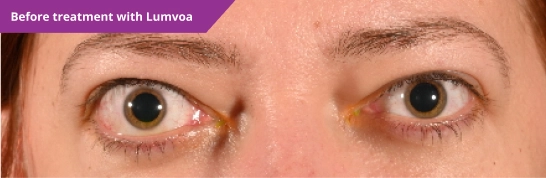
Eye bulging: 27 mm
Double vision: Occasional
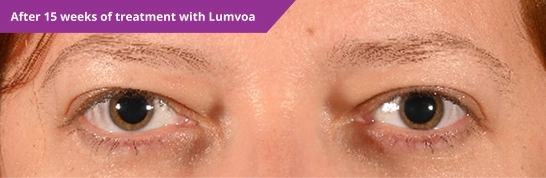
Eye bulging: 22.5mm after treatment
Double vision: Resolved
Following treatment with Lumvoa
On average, people who took Lumvoa and who had a response reduced their eye bulging at Week 15 by 3.7 mm
Not all patients treated with Lumvoa showed this much improvement. Written consent for these participant images was provided to the investigator (V.L.), courtesy of Imperial College Healthcare NHS Trust UK and Viridian Therapeutics, Inc. Individual results may vary
At 15 weeks, people taking Lumvoa reported in a survey overall improvement in visual function and appearance
This analysis was exploratory, meaning it was done to learn more, not to make firm conclusions about how the treatment works.

Visual Function
Includes activities such as driving, reading, watching TV, walking, biking, moving around the house, and hobbies.

Appearance
How people feel about their appearance, confidence, and social interactions.
These measures were determined through the Graves’ Ophthalmopathy Quality of Life (GO-QOL) questionnaire, which contains 8 questions on visual functioning and 8 questions on appearance.
This questionnaire was used to better understand patient experience, but it was not specifically designed or validated for TED, so the results should be interpreted with caution.
Measurements were gathered in 75 people taking Lumvoa and 38 people taking a placebo (a salt water infusion not containing medicine).
*Change in eye bulging was measured at week 15. A patient was considered a responder if the treated eye had a 2-mm improvement compared with the start of the study and the other eye did not worsen.
†Improvement in double vision was measured using a 4-point scale where scores ranged from 0 (no double vision) to 3 (constant double vision). Patients were considered responders if their double vision improved by 1 point from the start of the study by Week 15. Complete resolution meant that patients who had double vision at the start of the study reported no double vision at Week 15.
‡This exploratory analysis of 75 people taking Lumvoa and 38 people taking placebo examined additional patient‑reported information from participants who completed the Graves’ Ophthalmopathy Quality of Life (GO‑QOL) questionnaire, a 16-question survey used to track how you feel about the effect thyroid eye disease has on daily vision and physical appearance. It hasn't been officially "validated" (proven to be fully accurate) for all patients with TED. Because of this, the results should be viewed as a general guide rather than an exact measurement. An 8‑point change on the questionnaire represents a meaningful improvement that patients are likely to notice. Because this was not the main goal of the study, the results are not supportable with the highest level of confidence, and should be interpreted with caution.
Demonstrated results for chronic TED
The primary measurement of the study: how does Lumvoa affect eye bulging (proptosis)?
Less Eye Bulging (proptosis)
In chronic TED, improvement of eye bulging was seen at Week 15
57%
of people taking Lumvoa had reduced eye bulging at 15 weeks vs 8% with placebo*
(Lumvoa n=125 Placebo n=63)
Some people saw improvement of eye bulging as early as Week 3
About 57% of people who had reduced eye bulging at 15 weeks maintained their improvement at 52 weeks
A secondary measurement of the study: how does Lumvoa affect double vision (diplopia)?
Improvement in Double Vision (diplopia)†
56%
of people taking Lumvoa experienced improvement in double vision at 15 weeks vs 25% with placebo
(Lumvoa n=65 Placebo n=37)
Double vision completely went away at 15 weeks in
32%
of people taking Lumvoa vs 14% with placebo
80% of people who experienced resolution at 15 weeks maintained their results at 52 weeks
Double vision went away as early as 3 weeks with some people taking Lumvoa
At 15 weeks, people taking Lumvoa reported in a survey overall improvement in visual function and appearance
This analysis was exploratory, meaning it was done to learn more, not to make firm conclusions about how the treatment works.
Visual Function
People taking Lumvoa reported improvement in driving, reading, watching TV, walking, biking, moving around the house, and hobbies.
Appearance
People taking Lumvoa reported improvement in how they feel about their appearance, confidence, and social interactions.
These measures were determined through the Graves’ Ophthalmopathy Quality of Life (GO-QOL) questionnaire, which contains 8 questions on visual functioning and 8 questions on appearance.
This questionnaire was used to better understand patient experience, but it was not specifically designed or validated for TED, so the results should be interpreted with caution.
Measurements were gathered in 125 people taking Lumvoa and 63 people taking a placebo (a salt water infusion not containing medicine).
*Change in eye bulging was measured at week 15. A patient was considered a responder if the treated eye had a 2-mm improvement compared with the start of the study and the other eye did not worsen.
†Improvement in double vision was measured using a 4-point scale where scores ranged from 0 (no double vision) to 3 (constant double vision). Patients were considered responders if their double vision improved by 1 point from the start of the study by Week 15. Complete resolution meant that patients who had double vision at the start of the study reported no double vision at Week 15.
‡This exploratory part of the study involved 125 people who took Lumvoa and 63 people who took placebo, and it examined additional patient‑reported information from participants who completed the Graves’ Ophthalmopathy Quality of Life (GO‑QOL) questionnaire. The survey included questions about daily activities, appearance, and social experiences affected by thyroid eye disease. An 8‑point change on the questionnaire represents a meaningful improvement that patients are likely to notice. Because this was not the main goal of the study, the results are not supportable with the highest level of confidence, and should be interpreted with caution.
Potential side effects of Lumvoa
The most common side effects (occurring in 5% or more of patients) were:
Muscle spasms
Headache
Hearing problems
High blood sugar
Tiredness
Diarrhea
Ear discomfort§
Infusion reactions
Nausea
Cold-like symptoms
Increased blood creatine phosphokinase (CPK)
Dry skin
High blood pressure
In clinical studies, most patients (94%) completed all 5 infusions of Lumvoa.
Most side effects were mild or moderate and got better during or after treatment.
Menstrual changes (such as irregular or missed periods) were reported in about 29% of menstruating women who took Lumvoa, compared to 6% with placebo.
Lumvoa may cause hearing problems, including hearing loss. In some cases, hearing loss may be permanent. In clinical studies, most hearing-related events were mild, and most got better during or after treatment. Your doctor should check your hearing before, during, and after treatment.
Talk to your doctor if you are experiencing any side effects while on Lumvoa. These may not be all of the possible side effects of Lumova.
§Ear discomfort includes ear feels clogged or blocked, ear plugging, sensation of ear pressure, and ear popping.
How is Lumvoa given?
A full course of Lumvoa is 5 infusions given 3 weeks apart over 12 weeks.
During an infusion, medicine is delivered directly into your bloodstream through a needle placed in a vein—usually in your arm—that is connected to a small tube. Intravenous (IV) infusions are a common way doctors treat autoimmune and inflammatory conditions like TED.


Your first infusion will take about 45 minutes. If well tolerated, the remaining infusions take about 30 minutes each.